
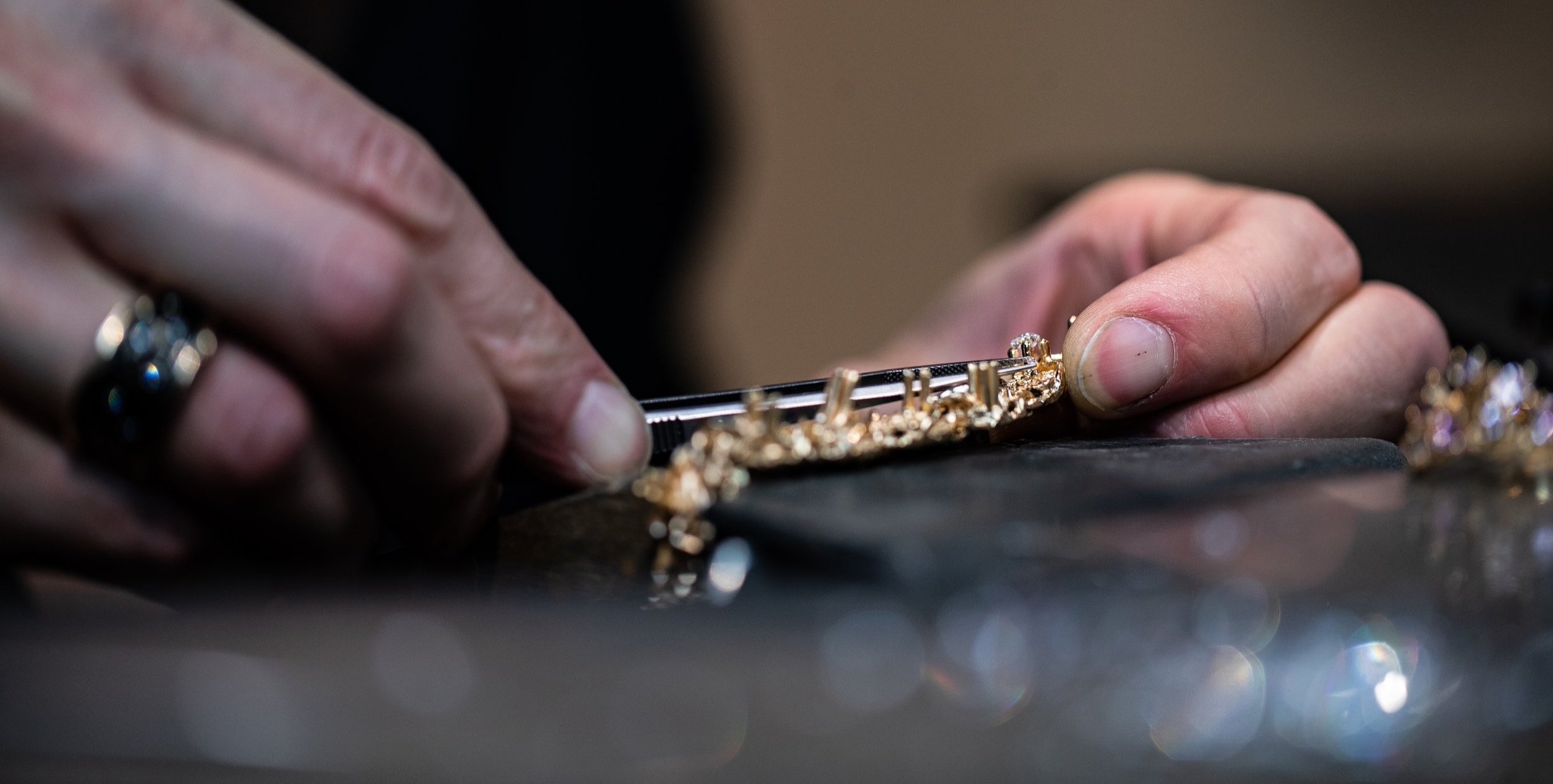
Precious metal
PRECIOUS METALS
Quality is our hallmark. That is why we take pride in using only the finest materials in all our jewelry. At the same time, we want to contribute to a better and more sustainable world, where fair trade is a natural part of our business.
We place a special emphasis on reusing materials.
Bring in the heirlooms from your drawer to have them transformed into new, contemporary jewelry that preserves your cherished memories. Visit us and help create new designs using your old gold, silver, and gemstones.
We regularly host lectures at the workshop, covering a variety of topics and featuring different speakers. These may focus on gold, diamonds, rubies, sapphires, pearls, or whatever is currently in the spotlight. The speaker might be the goldsmith himself or one of our suppliers, who will share stories about their travels, their work, and much more.
PRECIOUS METALS IN OUR JEWELRY
Gold

White gold
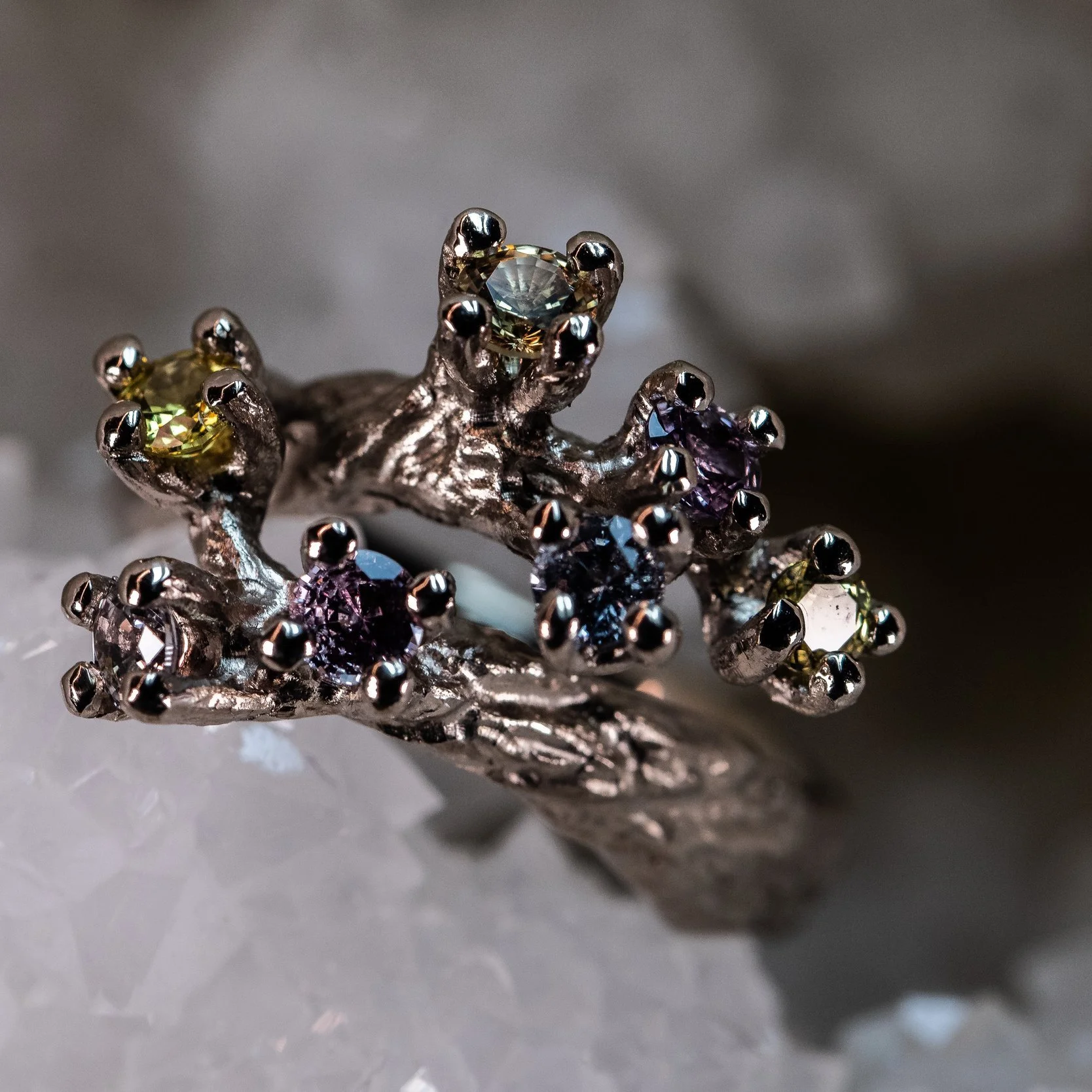
Silver

Platinum
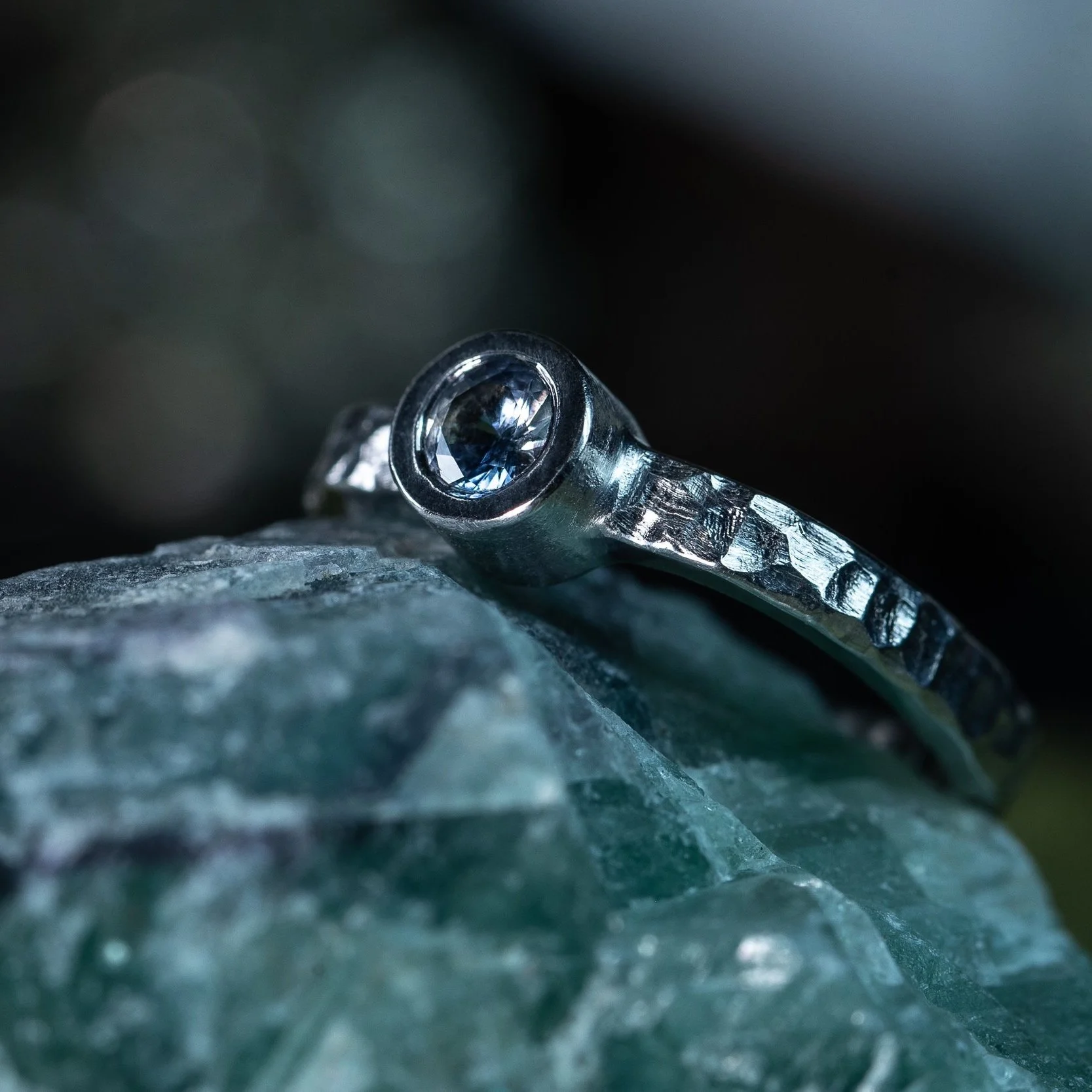
A CLEAR CONSCIENCE
At Mads Heindorf Jewellery, we are deeply committed to the materials we use, their applications, their origins, and how they are crafted. The jewelry industry is not the most sustainable or eco-friendly sector out there—let’s be clear about that from the start. But here at Mads Heindorf Jewellery, we do our best to minimize the industry’s impact on the environment. We do this by ensuring that our materials are as sustainable as possible without compromising on quality, so that the finished piece of jewelry can be worn with a clear conscience.
The materials trade is built largely on trust, which is why we only work with suppliers we trust. Our suppliers work closely with the people who work in the mines or out on the pearl farms. They travel out there, are involved in the process, and know how the work is done. They ensure quality and help ensure that the workers’ lives are healthy and decent, and as a business, we want to support that. We get materials of the highest quality—with a clear conscience.
PRECIOUS METAL
GOLD
For millennia, gold has captivated humanity and has helped to guide, heal, and seduce. However, the precious metal has had its greatest significance in the form of jewelry with a luster reminiscent of the sun’s life-giving light. In psychology, gold symbolizes a man’s unconscious image of a woman. As a secret connection. As love without words
We reuse your old gold in our new jewelry. The gold is cleaned, tested, and realloyed to ensure that its quality and purity meet even the strictest standards. In this way, you help spare the environment from the enormous amounts of pollution caused by the extraction of new gold.
ENVIRONMENTAL IMPACT OF GOLD MINING
When wethink of gold, we tend to think of gold rushes and romantic movies set in the past. Gold is no longer found by individual miners with pickaxes or gold panners standing with their pans to catch gold flakes in flowing rivers.
Today, gold is found almost exclusively in very small concentrations within a gold vein—less than 10 grams per ton—which is comparable in scale to 10 paper clips in a rock the size of a small car. To extract this tiny amount of gold, an open-pit mine must be constructed, where the gold vein is blasted and pulverized into a fine powder, after which chemicals are used to leach out the gold. Cyanide is one of the chemicals often used to dissolve and extract gold, and even in very small amounts, this substance is extremely harmful to human and animal health.
Cyanide used in gold mining can leak and seep into the soil and groundwater surrounding a gold mine. In Romania in 2000, cyanide contamination affected the drinking water of over 2.5 million people, and countless fish, birds, and other animals perished.
In addition to groundwater contamination, there is the environmental issue of how to dispose of the unwanted "tailings" left over after mining. The metal mining industry produces more toxic environmental pollution than any other industry. In the United States, the metal mining industry is responsible for 96% of arsenic emissions and 76% of lead emissions. Every year, U.S. mines generate a volume of waste equivalent in weight to nearly nine times the total amount of waste from all U.S. cities combined.
To understand the scale of the problem, consider this: producing the amount of gold equivalent to an average 18-karat gold ring results in 20 tons of mining waste and pollution.
In addition to the environmental impact on workers in the gold mining industry and the people living nearby, gold mining companies are also sometimes guilty of human rights violations.
ABOUT GOLD, ALLOYS, AND HALLMARKS
Gold is best known in three alloys—8, 14, and 18 karat. Gold in its purest form is 24 karat and is called fine gold. It is very rare to make jewelry out of fine gold because it is too soft. That is why an alloy is created. In this process, small amounts of harder metals, such as silver, palladium, and copper, are added to make the gold harder.
In Denmark, it is a legal requirement that all jewelry be hallmarked with the jeweler’s or manufacturer’s mark, as well as the alloy or purity of the precious metal.
18-karat gold jewelry must be marked "750," because 750 out of 1,000 parts of the alloy are pure gold.
14-karat gold jewelry must be marked "585," because 585/1000 of the alloy is pure gold.
8-karat gold jewelry must be marked "333," because 333/1000 of the alloy is pure gold.
In addition, there are several different shades of gold. The most well-known are red gold, yellow gold, white gold, and rose gold. These different colors are achieved through alloying. If a large amount of copper is added to the gold, it will take on a redder or pinker hue.
Conversely, white gold contains a higher proportion of palladium, a hard, grayish-white metal that lightens the gold and makes it appear whiter. However, a completely white color cannot be achieved through alloying alone. For this reason, finished white gold jewelry is often given a rhodium plating to make it completely white.
THE GOLD AT MADS HEINDORF JEWELRY
At Mads Heindorf Jewellery, we strive to be as environmentally conscious as possible. That is why we have chosen to use only recycled gold in our jewelry collections, so we do not contribute to the pollution caused by gold mines. We use what already exists and give the gold a new lease on life. Because that’s the thing about gold—it never loses its value, and since it’s a precious metal, it never loses its beauty and luster either. We therefore encourage you to bring in your old gold if you’d like to have your own personalized piece of jewelry made—it gives the jewelry a special story to know that Grandma’s old gold ring has been given new life in a new piece of jewelry.
WHITE GOLD
White gold is a man-made alloy that typically consists of gold, silver, and palladium. The alloy was developed because many people feel that the color of gemstones complements gold better when it has a beautiful white sheen. White gold is stronger than silver and easier to work with than platinum. And even though the precious metal is created by human hands, its ingredients come from the earth. It is genuine enough.
SILVER
Silver has proven healing properties for those who wear this beautiful precious metal, as microorganisms, bacteria, and various types of viruses are killed by silver. Because of its bright, shining luster, silver has become a symbol of the moon and, in folklore, has been used to ward off demons and witches. With a piece of silver jewelry, you are thus protected both day and night.
PLATINUM
“Platinum is the only metal fit for a king,” declared Louis XV of France. It is, in fact, the finest and most expensive of all precious metals. And it is 30 times rarer than gold. With its radiant luster, it captivates the most exquisite women. And with its elegant discretion, noblemen bow in reverence. Nothing surpasses it, and nothing comes close—platinum is the king of metals.